The ice winter of 2026 in the Baltic Sea set a 10-year record. On February 20, sea ice covered an area of approximately 160,000 km² in the Baltic Sea. During a short period in February, nearly the entire coastal area of Estonia was frozen over. Under favorable conditions, ice roads were opened for a short period in Western Estonia, and due to difficult conditions, icebreakers remained in operation until early April.
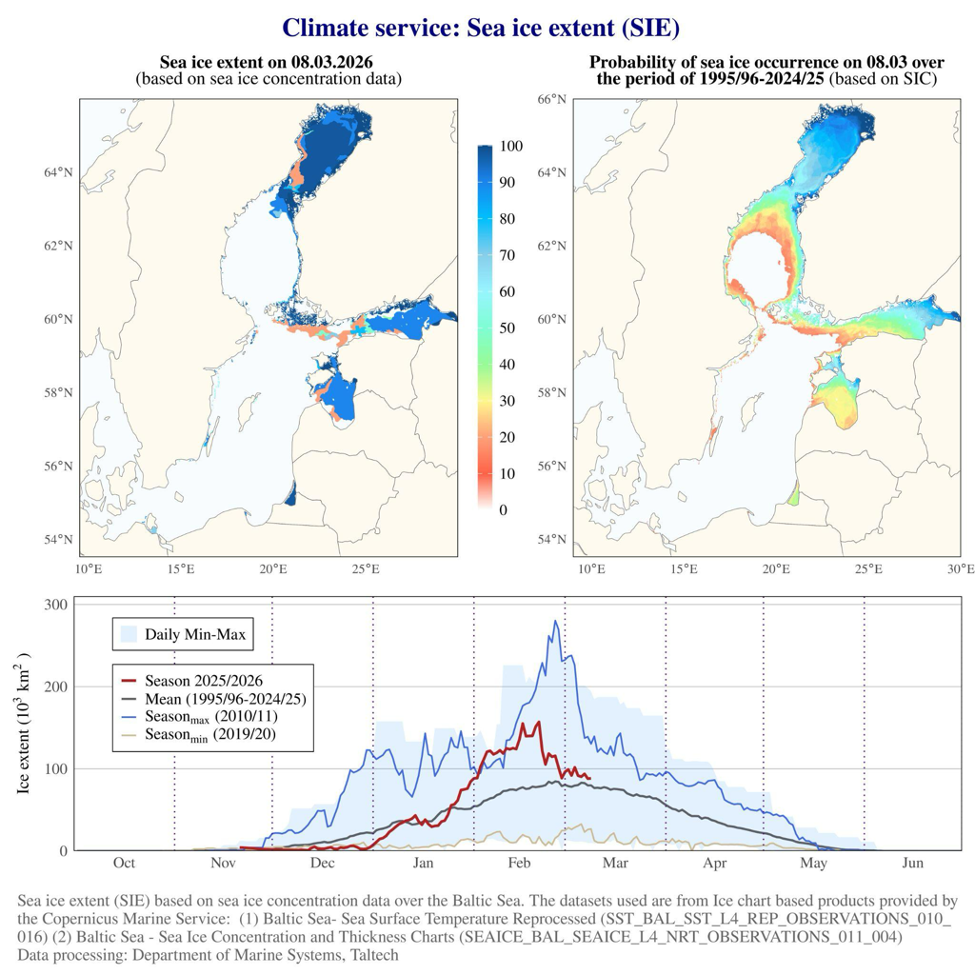
The Baltic Sea ice season began already in the second half of November, but due to warmer-than-average weather, ice coverage remained limited until the end of December. With the arrival of colder temperatures in early January, sea ice extent began to grow rapidly and continued to increase gradually until mid-February. Ice formation started in the northern part of the Gulf of Bothnia, followed by the mouth of the Neva River and the coastal areas of Western Estonia, Pärnu Bay, and the Curonian Lagoon. Maximum ice extent was reached on February 20; as the sea ice also appeared as a narrow strip along the eastern coast of southern Sweden, in the Pomeranian Bay, and in places within the Danish Straits. The ice remained at its maximum extent (approx. 155,000 km², or about 37% of the Baltic Sea surface) for less than a week before beginning to retreat as the weather became warmer.
According to Rivo Uiboupin, Director of TalTech’s Institute of Marine Systems, this year’s ice season was record-breaking over the past 10 years and resembled the year 2018, when sea ice extent reached approximately 145,000 km² in early March. However, this year’s ice winter still fell short of the record winter of 2011, when ice coverage approached 300,000 km² (around 74% of the Baltic Sea surface).
At its peak, Estonia’s coastal waters were almost completely frozen over — ice of varying thickness covered the Väinameri Sea, Pärnu Bay, and most of the Gulf of Finland. Open water could only be seen along the northwestern coast of Estonia, from Pakri Bay to the Noarootsi Peninsula, and west of Hiiumaa and Saaremaa islands. Thanks to suitable ice conditions, ice roads were briefly opened in the second half of February between the mainland and Vormsi and Kihnu islands, as well as a connection route between Hiiumaa and Saaremaa.
What Do the Ice Conditions Tell Us?
Ice conditions reflect atmospheric processes, and comparison with long-term data shows that January and February were indeed significantly colder than average (Estonian Environment Agency). Although March was again warmer than average, ice conditions persisted until early April, and the official icebreaking season ended on April 13 (Republic of Estonia Transport Administration). Compared with the long-term average and other record winters, this year’s ice season was still shorter — rapid ice formation only began in January, and the period of extensive ice cover, excluding isolated ice fragments in the northern Gulf of Bothnia, ended before May. These data are consistent with broader climate change trends.
Intense ice winters like the one experienced in 2026 demonstrate that climate change does not produce straightforward warming; unexpectedly cold winters can still occur. This winter, Estonian icebreakers operated for 98 days, and the Estonian State Fleet has compared the complexity of the ice conditions to those of 2011. It can be assumed that similar winters will continue to occur despite the general warming trend.
According to the Finnish Meteorological Institute, the Finnish ice winter of 2025–2026 shows a similar pattern, highlighting the high variability of Baltic Sea ice conditions. Although ice extent grew rapidly in January and reached a relatively large maximum in February (around 181,000 km²), the season was characterised by its short duration and early end. An exceptionally mild March accelerated ice decay, and the Baltic Sea became almost entirely ice-free by 10 May, close to a record-early date. At the same time, regional contrasts remained pronounced, with extensive ice in the north while parts of the central Bothnian Sea stayed ice-free. These observations further support the conclusion that, despite occasional intense ice winters, the overall trend is towards shorter and more variable ice seasons.
A Digital Twin Helps Study Baltic Sea Ice
Climate change presents a major challenge for protecting the Baltic Sea environment and for strategic planning. To make informed decisions, we need high-quality data and as accurate future projections as possible. This is where the Baltic Sea digital twin comes in, the development of which is part of the daily work at TalTech’s Institute of Marine Systems, in cooperation with scientists from the Alfred Wegener Institute (AWI).
Rivo Uiboupin, who coordinates digital twin development at the Institute of Marine Systems, explains:
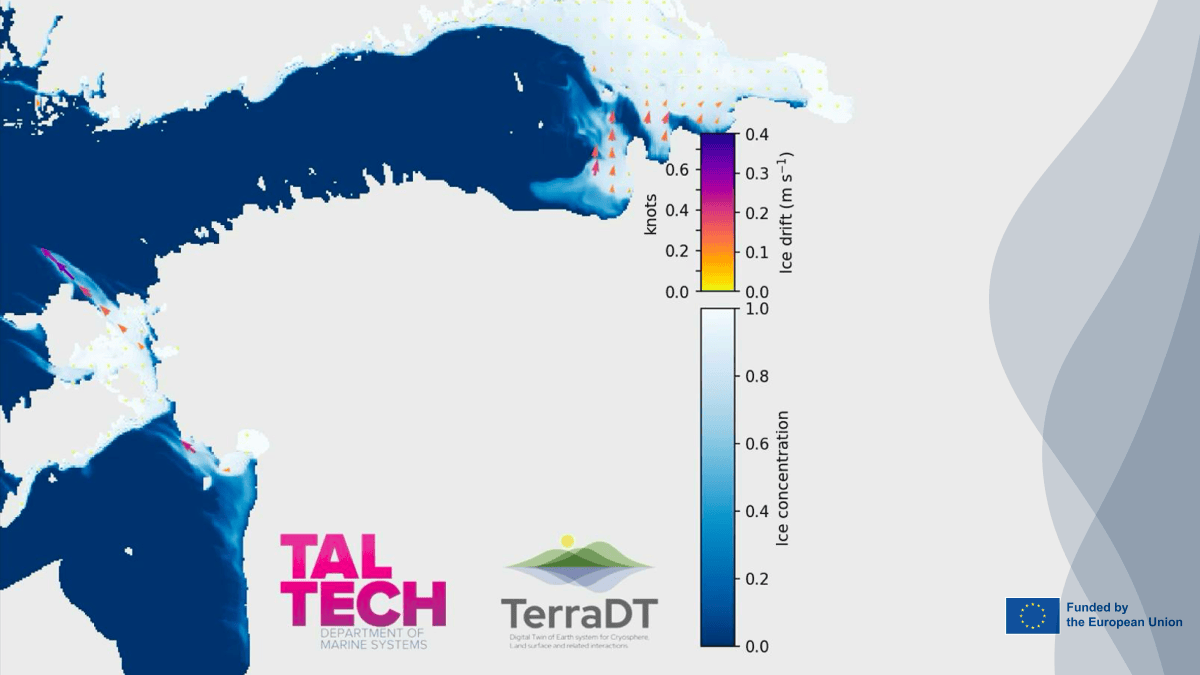
“Digital twin simulations make it possible to model key sea ice variables such as ice thickness, drift, and concentration. The Baltic Sea digital twin helps to identify trends in ice formation, movement, and decay, and assess the probability of severe ice conditions over time and under different climate scenarios. This enables stakeholders to evaluate risks and plan activities and infrastructure in the Baltic Sea.”
The digital twin for analysing the Baltic Sea ice conditions is part of the TerraDT project (https://terradt.eu) coordinated by CSC – IT Center for Science, the Finnish supercomputing center. In addition to sea ice, the project develops digital twin applications for the land ice, forest, and urban planning domains.
"The sea ice digital twin component, including its application to the Baltic Sea, is a great example of what TerraDT is built to deliver — translating complex Earth system science into insights that are directly relevant to industries and communities facing the realities of a changing climate. It is precisely this kind of actionable, user-relevant output that we are working towards: digital twins of the Earth system that don't just advance our scientific understanding but equip decision-makers with the tools they need to plan, adapt, and act"
says Jenni Kontkanen, the coordinator of TerraDT.
The winter of 2026 serves as a reminder that climate change is not defined by the absence of cold extremes, but by increasing variability and unpredictability. A season that produced the largest Baltic Sea ice extent in a decade also ended earlier than many historic ice winters, illustrating how rapidly conditions can shift. For communities, industries, and policymakers that depend on the Baltic Sea, the challenge is no longer simply understanding what has happened in the past, but anticipating what may happen next. As climate patterns become less predictable, tools such as digital twins offer a new way of thinking about environmental change in a time when the question is: how well can we understand and adapt to change before it unfolds?