Over the past weeks, TerraDT has run three events that show two sides of the project. Two were about the technical work behind its digital twin components, from machine learning emulators to model coupling on Europe’s supercomputers. The third was about the users who will one day rely on them. Here’s a look at what happened.
TerraDT Tech Talks: machine learning from emulators to impact models
On 17 September, TerraDT opened the TerraDT Tech Talks, a new strand of the project’s public webinar programme dedicated to the more technical side of its work. The first edition gave an accessible overview of how machine learning is used across TerraDT. A central idea behind TerraDT is a modular, generic coupling interface. It lets physics-based model components be complemented, and in some cases replaced, by AI emulators that reproduce demanding processes at a fraction of the computational cost. That makes the high-resolution, multi-decadal simulations needed by DestinE’s Climate Digital Twin feasible.
Here, speakers covered different topics: the role of machine learning in TerraDT, machine learning for urban impact assessment of carbon sequestration and climate extremes, machine learning for building a high-resolution, time-varying land-use dataset, coupling of AI-driven and physics-based digital twin components, and machine learning approaches in the WeatherGenerator project.
Machine Learning for Earth System Science: hands-on in Ostrava
The webinar’s themes were explored in more technical depth on 20–21 October at the IT4Innovations National Supercomputing Center in Ostrava (CZ). There, TerraDT partners and sister projects took part in a two-day workshop on developing ML models on HPC systems and coupling them with numerical simulations.
The first day was hands-on, working directly on two EuroHPC machines: MareNostrum 5 (BSC) and Karolina (IT4Innovations). Participants explored software stacks and efficient container building and deployment. They also practised moving between heterogeneous systems, training a model on one supercomputer and running inference on another.
The second day turned to the fundamentals of Earth system model coupling. It covered how to integrate components with the YAC (Yet Another Coupler) library and the ICON Community Interface (ComIn), taught by YAC developers Moritz Hanke and Benjamin Rodenberg (DKRZ). Case studies from TerraDT, including AI4Land’s global high-resolution land-use reconstruction and an ML pipeline for aerosol particle predictions, grounded the sessions in real project work.
Digital Twins for Land Ice: connecting users across projects
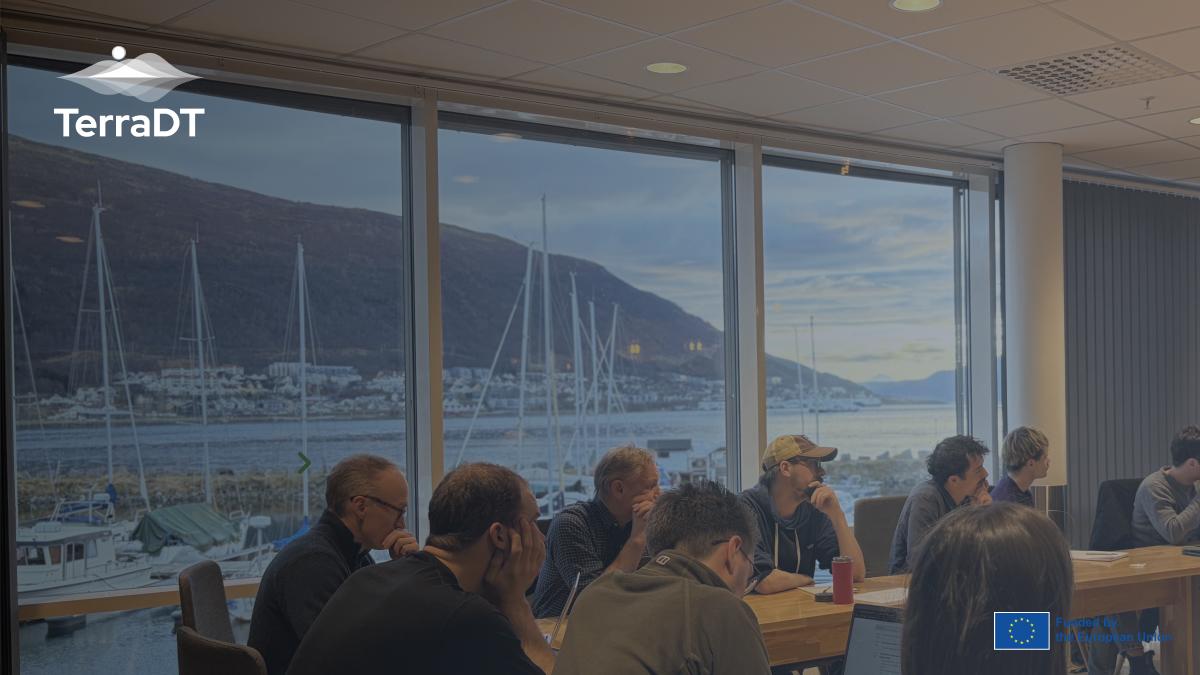
On 27 October, TerraDT joined forces with the Svalbard Cryosphere Digital Twin (SvalbardDT) project for a user workshop at the Fram Centre in Tromsø (NO). Both projects share a strong interest in the Arctic, especially SvalbardDT, with the potential to scale their findings and applications globally.
The workshop focussed on TerraDT Land Ice Digital Twin Component (DTC) and Impact Model, introduced by Thomas Zwinger from CSC - IT Center for Science and Clemens Schannwell from Max Planck Institute for Meteorology - describing the latest advances in Elmer/Ice, including improved calving algorithms and subglacial hydrology.
The synergy between the projects came through clearly after their overviews, showcasing how Svalbard glacier datasets feed directly into TerraDT.
Looking Ahead
Together, these events show the range of TerraDT’s work: opening technical topics to a wider audience and working with user communities to shape tools that meet real needs. As the project continues, we will build on these connections so that TerraDT’s digital twin components help communities adapt to a changing climate.